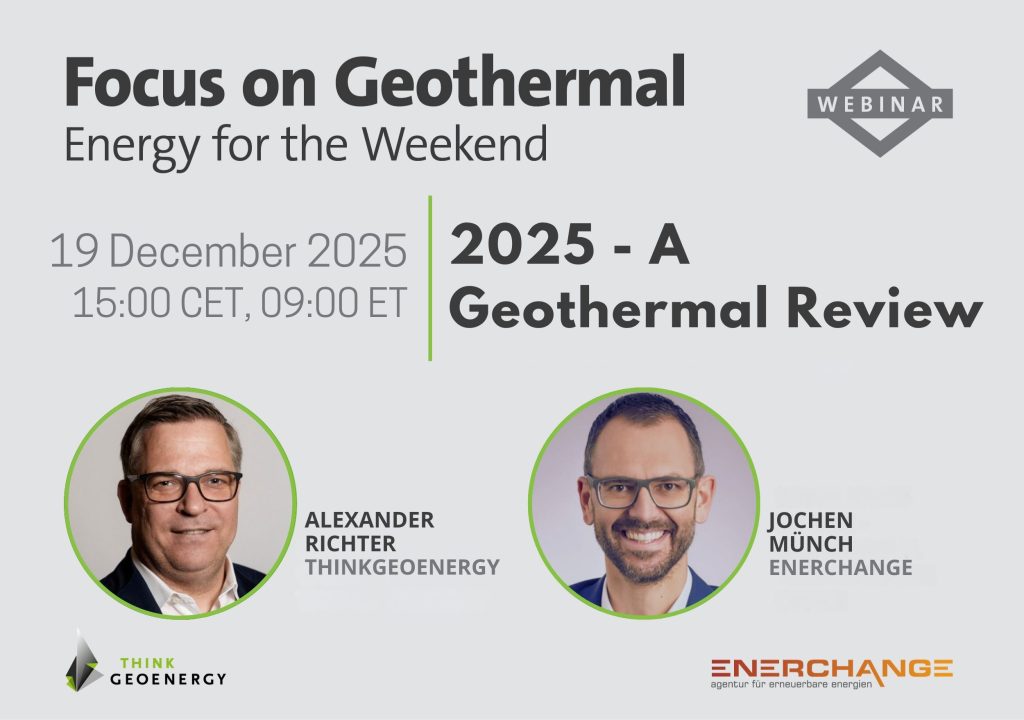
Before the year ended, ThinkGeoEnergy and Enerchange hosted a year-end webinar summarising key developments across the global geothermal sector. The session reviewed progress in power and heat markets, technology trends, regional dynamics, and broader industry signals that shaped the year.
Rather than focusing on individual announcements, the discussion placed developments into a wider market context, highlighting both areas of progress and the structural challenges that continue to define geothermal deployment.
Global capacity growth and market signals
Installed geothermal capacity continued to increase in 2025, though growth remained uneven across regions. New projects moved forward in established markets, while emerging regions showed signs of renewed interest, often linked to energy security and decarbonisation goals.
The webinar highlighted that while geothermal remains a long-term infrastructure investment, policy clarity and risk mitigation frameworks are becoming increasingly important in determining which projects advance from planning to drilling.
Technology developments and next-generation geothermal
Advanced and next-generation geothermal technologies were a central theme of the discussion. Enhanced geothermal systems, closed-loop concepts, and high-temperature applications received growing attention from policymakers, investors, and industrial players throughout the year.
The webinar emphasised that while these technologies have significantly expanded geothermal’s potential addressable market, timelines for commercial scale-up remain measured. Pilot projects, operational data, and continued learning will be key factors in determining their long-term impact.
Heat, district energy, and regional focus
Geothermal heat featured prominently in the year-end review, particularly in the European context. District heating decarbonisation, industrial heat demand, and energy price stability have pushed geothermal heat higher on political and utility agendas.
At the same time, the webinar noted that implementation challenges persist. Permitting, financing structures, and risk-sharing mechanisms continue to influence development speed, even where policy support exists.
A more visible, more complex geothermal landscape
Another key takeaway from the discussion was the changing visibility of geothermal energy. The sector now attracts a wider range of stakeholders, including large energy companies, technology startups, public institutions, and non-governmental organisations.
This increased attention reflects geothermal’s growing relevance but also adds complexity to market dynamics, competition for capital, and public communication around expectations and timelines.
Outlook for 2026
Looking ahead, the webinar concluded that geothermal enters 2026 with a broader opportunity set than in previous years. New technologies, stronger policy interest in heat, and growing awareness of geothermal’s role in energy security provide a solid foundation.
At the same time, progress will continue to depend on execution. Project delivery, cost control, regulatory clarity, and realistic expectations remain central to sustained growth.
Watch the full webinar recording below: