
Public trust matters: What research says about communicating geothermal energy

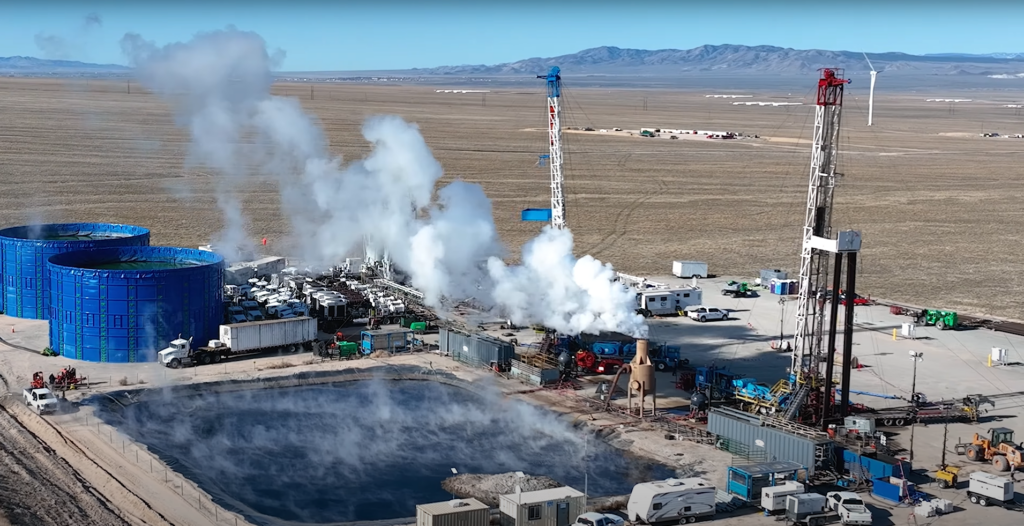
New research by CATF highlights how clear safety messaging, local benefits, and trusted voices shape public acceptance of geothermal energy projects.
As geothermal energy development expands into new regions, public perception is increasingly shaping whether projects move forward or stall. According to recent research led by Ann Garth, Senior Geothermal Associate at the Clean Air Task Force (CATF), how geothermal projects are communicated and how local communities are engaged can be as important as the underlying geology or technology.
The findings are based on extensive quantitative and qualitative research, including surveys and focus groups, designed to test how different messages about geothermal energy are received by the public. The work aims to identify best practices for both community engagement, defined as interactions with people living near project sites, and broader public communications, including outreach to the general public and media.
Safety and competence resonate more than technical detail
One of the clearest findings from the research is that messages focused solely on technical explanations of geothermal systems tend to underperform. By contrast, messages that combine technical information with clear assurances about safety, regulation, and monitoring consistently resonate more strongly.
“The public wants to know that people running these projects know what they are doing,” Garth explained during the interview. Emphasising competence, oversight, and risk management helped build confidence, even among audiences with limited prior exposure to geothermal energy.
However, the research also highlights a challenge, particularly in the United States. Public trust in government institutions is low, with agencies such as the U.S. Department of Energy scoring poorly in trust surveys. This complicates messaging that relies heavily on regulatory frameworks as reassurance. In European contexts, where trust in public institutions tends to be higher, similar messages may be received differently, though this is only a hypothesis as CATF’s research did not cover European audiences.
Industry trust and the role of third-party voices
Distrust of private companies emerged as another recurring theme. Associations with oil and gas companies, in particular, often reduced trust when explicitly highlighted in geothermal messaging. According to the research, references to oil and gas origins or corporate links can trigger scepticism about motives, even when technologies or skills are being repurposed for geothermal development.
More effective approaches include framing workforce transitions in practical terms or focusing on the application of existing technical expertise without emphasising its origin. The research also shows the value of trusted third-party validators. Independent experts, local leaders, and community members who can speak to project impacts often carry more credibility than developers or companies alone.
Local benefits drive community acceptance
For communities near project sites, tangible local benefits remain central. Research cited in the discussion, including work by organisations such as Greenlight America, shows that highlighting local economic impacts significantly improves acceptance of energy projects.
In the case of geothermal, these benefits can include local tax revenues, employment, and, in some jurisdictions, royalties that flow directly to local or state governments. In the United States, geothermal has historically benefited from royalty structures that allocate a share of revenues locally, contributing to comparatively higher acceptance than some wind or solar projects. Recent policy efforts aim to extend similar benefit-sharing approaches across other renewable technologies.
Different regional dynamics in the U.S. and Europe
While the research focused exclusively on the United States, it nevertheless points to regional variation within the U.S. itself, underlining the importance of tailoring geothermal communication strategies to local context. According to Garth, public concerns, levels of familiarity with geothermal energy, and trust in institutions vary significantly across regions, even within a single country.
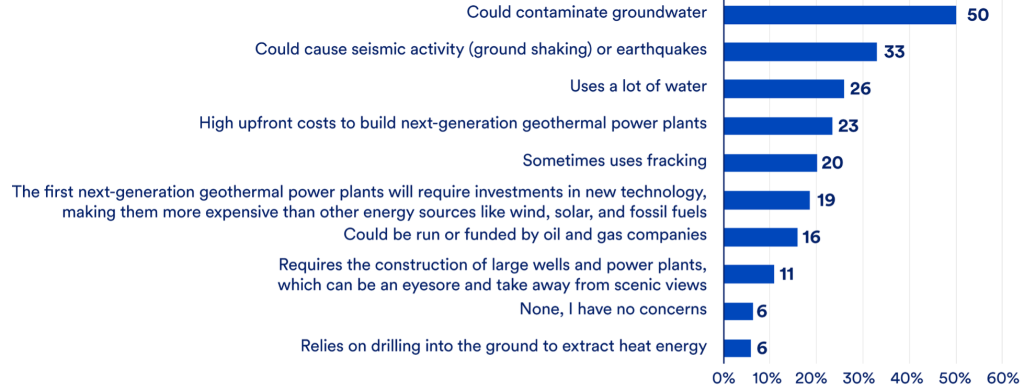
As observed by ThinkGeoEnergy through its reporting, in Europe concerns around induced seismicity, particularly in relation to enhanced geothermal systems, are predominant themes when it comes to opposition and questions about geothermal development. In the U.S., so CATF’s research groundwater contamination is seen as a key concern.
Public concerns about next-generation geothermal energy
Survey responses to the question: “After everything you have read, which of these do you find the most concerning?
Select up to two.”

Source: CATF
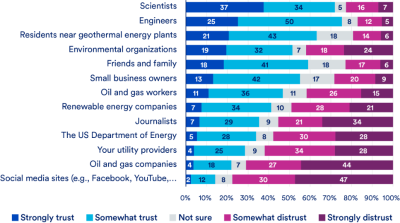
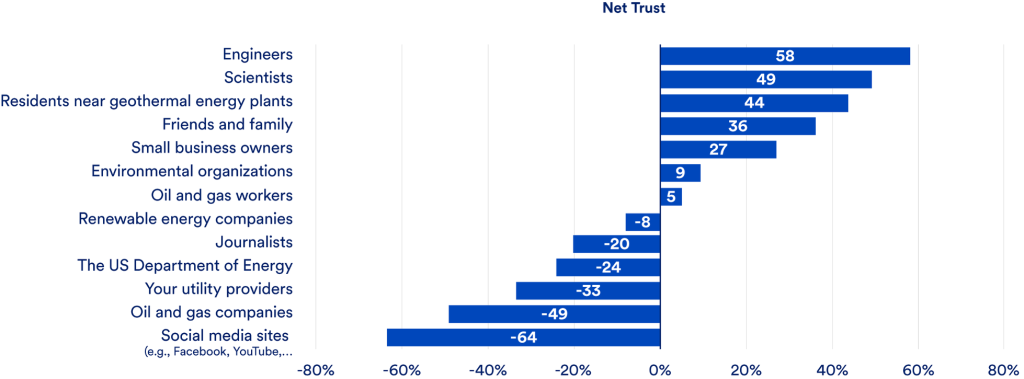
At the same time, the research of CATF highlights uneven levels of trust in institutions and information sources in the U.S. Social media, oil & gas companies, followed by the U.S. Department of Energy, are often met with scepticism on the level of trustworthiness, complicating communication strategies that rely heavily on regulatory oversight as reassurance. Trust levels varied more positively for scientists, engineers and local residents living near geothermal facilities, reinforcing the value of third-party validators in public communication.
Trust in information sources on geothermal seismicity risks
Survey question: How much do you trust each of the following when it comes to information about the seismicity (ground shaking) and earthquake risks of next-generation geothermal energy?

Net Trust in information sources on geothermal risks
(Net trust = trust minus distrust)

Source: CATF
Trying to draw parallels to Europe in the discussion with ThinkGeoEnergy, Garth cautioned against drawing direct comparisons between regions without empirical evidence. Perceptions of geothermal risk, institutional trust, and acceptance of new energy technologies are shaped by local political, cultural, and historical factors. As a result, assumptions about how European communities may respond to geothermal messaging remain speculative at this stage.
The key takeaway from the U.S. findings is not a fixed set of messages that work everywhere, but rather the importance of grounding communication strategies in local realities. Understanding which concerns dominate, which institutions are trusted, and which voices carry credibility is essential for building public confidence in geothermal projects.
We thank Ann and the CATF team for the great work on this public communication research, but of course also on the great work on the topic of superhot rock/ supercritical resources. Learn more about CATF’s work on superhot rock geothermal here.