Underground Thermal Energy Storage (UTES) is increasingly being recognized as a critical enabler of the energy transition, offering a practical solution to one of the most pressing challenges of renewable energy systems – intermittency. By leveraging the natural storage capacity of the subsurface, UTES allows surplus heat and cold to be stored and reused across seasons, improving both energy efficiency and system flexibility.
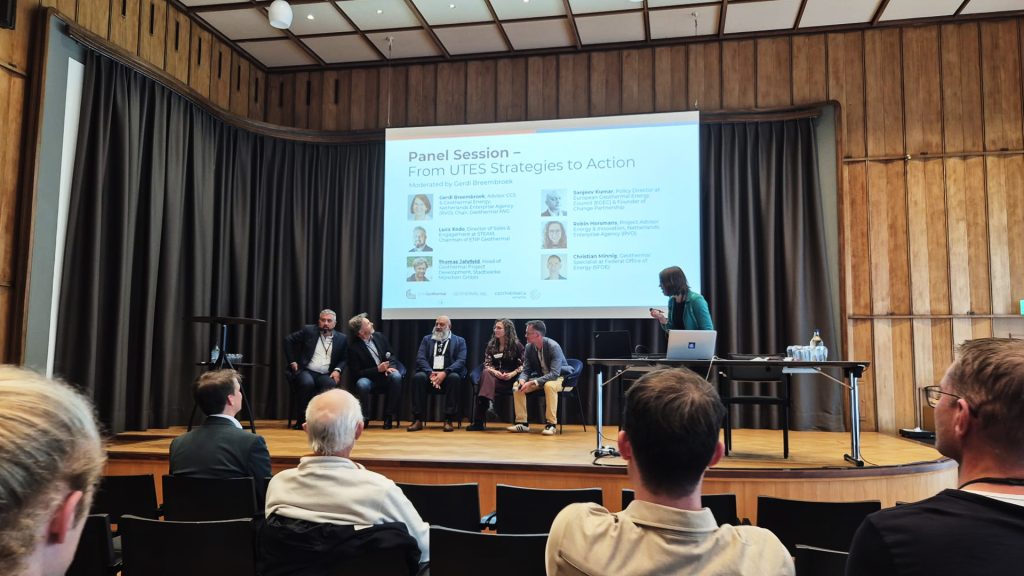
Discussions among policymakers, industry stakeholders, and researchers in recent European geothermal gatherings have reinforced both the maturity of the technology and the urgency of scaling its deployment. What is becoming clear is that UTES, at times reframed more simply as “geothermal storage,” is moving from a niche application to being a core component of future energy systems.
Storage is key!
As renewable penetration increases, so too does the mismatch between when energy is produced and when it is needed. Solar energy peaks in summer, while heating demand rises sharply in winter. Underground thermal energy storage offers a practical solution to this imbalance.
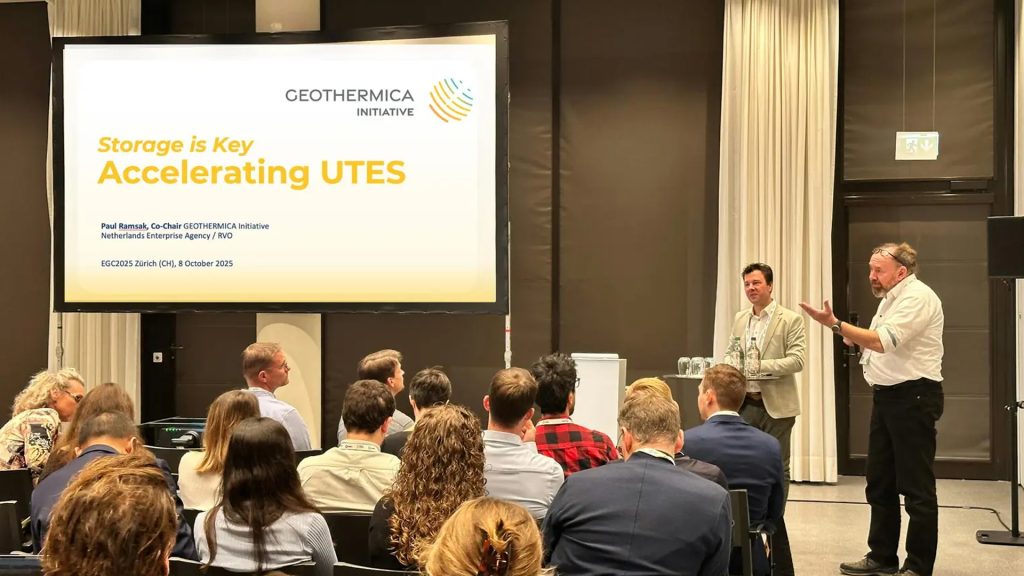
“We need to bring the heat from summer to winter, and the cold from winter to summer,” explained Paul Ramsak of the Netherlands Enterprise Agency and co-chair of the GEOTHERMICA initiative.
Beyond seasonal balancing, UTES is increasingly being viewed as a tool to manage grid congestion. In countries like the Netherlands, where electrification is accelerating rapidly, grid infrastructure is already under strain. By shifting part of the energy demand into thermal storage, UTES can help relieve pressure on electricity networks while reducing the need for costly grid expansion.
This broader role is also reflected in a shift in terminology – from technical acronyms such as ATES or BTES toward the more accessible concept of “geothermal storage.” The change reflects a growing effort to position UTES not as a niche technology, but as a central pillar of a future renewable energy system.
Technology that already works
While discussions around energy storage often focus on emerging technologies, underground thermal energy storage is already being deployed at scale.
“What we try to show is that it is already there – you can do it,” Ramsak emphasized. “Whatever your underground is, there is a kind of thermal storage solution that will work for it.”
Across Europe, a diverse portfolio of UTES solutions is in operation or under development, tailored to local geological conditions:
- Aquifer Thermal Energy Storage (ATES): Widely used in the Netherlands, where suitable aquifers enable large-scale heat storage at relatively low cost
- Borehole Thermal Energy Storage (BTES): Applied in areas without aquifers, using arrays of boreholes to store thermal energy in the ground
- Mine water storage: Repurposing flooded coal mines, particularly in regions of the Netherlands and Germany
- Cavern thermal energy storage systems: Including large underground reservoirs being developed in Finland and Austria, often linked to district heating networks
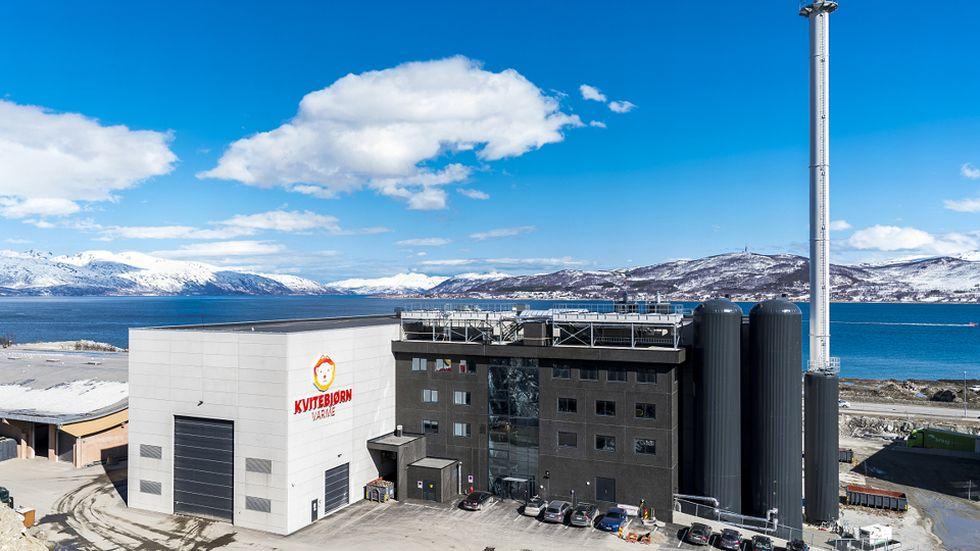
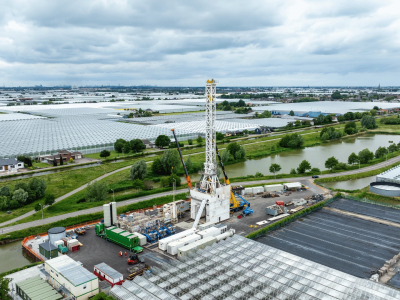
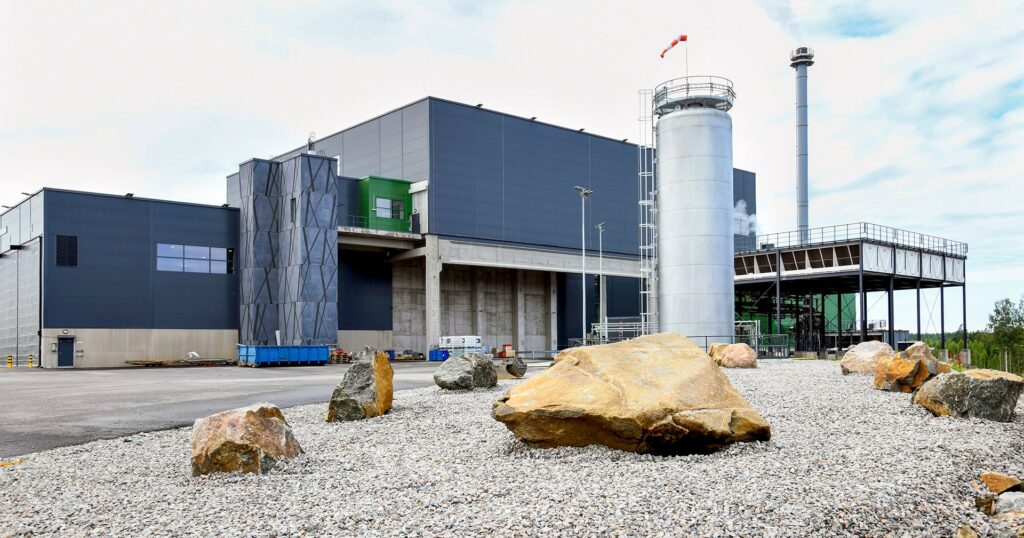
The growing number of operational projects across the continent demonstrates that UTES is both technically viable and commercially relevant. The sector is steadily moving from pilot-scale initiatives toward broader deployment. Notable projects discussed during the UTES symposium in Zurich in 2025 include the High Temperature Aquifer Thermal Energy Storage (HT-ATES) system in Delft in the Netherlands, and a Fracture Thermal Energy Storage system in Tromsø, Norway.
The importance of cross-country collaboration
The progress seen in UTES deployment is closely linked to collaboration between public authorities, research institutions, and industry stakeholders. This approach is embodied by the GEOTHERMICA initiative, a cooperation of public authorities from different member countries working together to advocate for geothermal solutions, including UTES.
As a network of national agencies and ministries, GEOTHERMICA plays a key role in aligning strategies, sharing best practices, and identifying common priorities across countries. This coordination is particularly important in a sector where regulatory frameworks and market conditions can vary significantly.
“It is crucial to have support from the public side,” Ramsak noted, highlighting the influence of policy on the evolution of energy systems.
Over the past years, underground thermal energy storage has emerged as a dedicated focus area for cross-country collaboration. Workshops, knowledge-sharing platforms, and joint initiatives have helped build a growing community of stakeholders, facilitating both technical exchange and project development.
Beyond technology, collaboration also extends to policy instruments, urban deployment strategies, and financing mechanisms. By sharing experiences across borders, countries can accelerate implementation and reduce the risks associated with new developments.
UTES outside Europe
While Europe currently leads in the deployment of underground thermal energy storage, interest in the technology is expanding globally. “There is definitely interest from outside Europe,” Ramsak said, pointing to growing engagement from regions such as Asia and the Americas.
International collaboration is expected to play an important role in the next phase of development, with global geothermal platforms providing opportunities to exchange knowledge and showcase projects from different regions.
The global relevance of UTES lies in its dual capability to provide both heating and cooling. This makes deployable across a wide range of markets – from cold climates with high heating demand to warmer regions requiring seasonal cooling solutions. As countries worldwide seek to decarbonize their energy systems while maintaining reliability, underground thermal energy storage offers a flexible and scalable pathway forward.
The outlook for UTES is increasingly clear: the technology is proven, and heating and cooling system need a mechanism to balance fluctuations in supply and demand. As the energy transition accelerates, the ability to store heat and cold in the subsurface may prove to be one of the most practical and impactful solutions available.
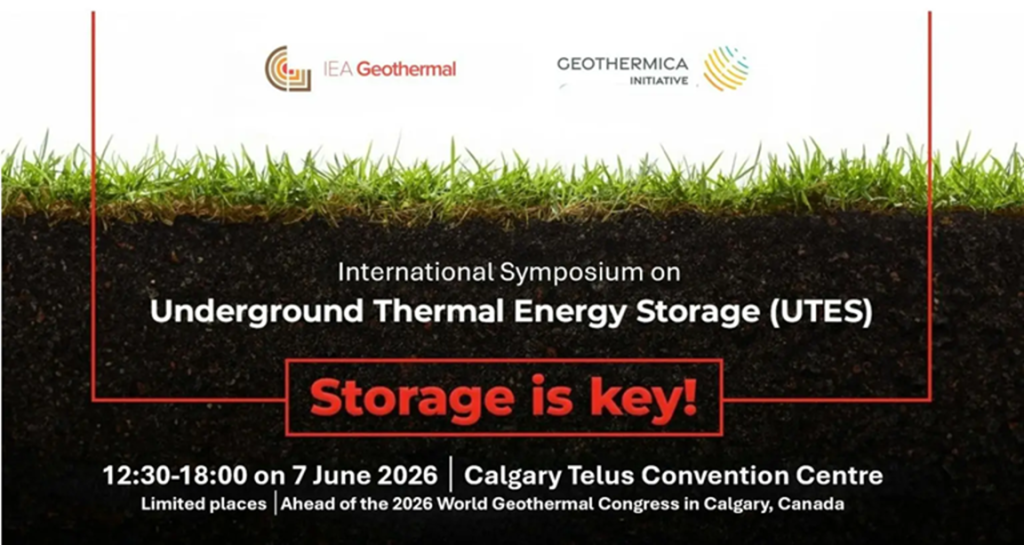
UTES projects outside of Europe will be on the spotlight at the next “Internati0nal Symposium on Geothermal Storage (Underground Thermal Energy Storage),” happening just ahead of the 2026 World Geothermal Congress. With speakers from North America, Europe, and Asia, the event will give a comprehensive overview of the latest developments in UTES around the world. The event details are as follows:
Date & Time: 7 June 2026, 12:30 – 18:00
Venue: Calgary Telus Convention Centre
The event is free of charge but seating is limited, so interested participants need to register. Click here to register. The event is being organized by the GEOTHERMICA Initiative and IEA Geothermal.