Project InnerSpace has released a detailed assessment of the United Kingdom’s geothermal resource base and deployment outlook, arguing that geothermal energy could move from a marginal contributor to a strategic pillar of the UK’s heat and power system if policy, finance, and data gaps are addressed. Titled “The Future of Geothermal in the United Kingdom: Affordable, Renewable, and Locally Produced Energy for a Resilient Future“, the report frames geothermal as a largely overlooked asset for energy security and decarbonisation, particularly in the wake of recent gas price shocks. The report was released on February 5, 2026 at event in London, UK. This follows similar reports, e.g. on Indonesia.
“The United Kingdom stands at a historic energy crossroads,” said Drew Nelson, Vice President of Programs, Policy, and Strategy. “This report shows that harnessing the heat beneath our feet, starting with practical deployments through heat networks and anchor customers like the NHS, can lower bills over time, strengthen energy security, and create high-quality jobs across the country. The opportunity is vast, and it’s one we can seize now using the skills and technologies the UK already has.”

The report was led by Project InnerSpace in collaboration with authors, contributors, and peer reviewers from Newcastle University, Durham University, Imperial College, National Geothermal Centre, Net Zero Technology Centre, University of Glasgow, ARUP, Renewable Energy Association (REA), Sidley Austin, Eden Geothermal, Ember Energy, Geothermal UK, Hephae Energy Technology, Geothermal Wells, and University of Manchester.
A large but underused domestic resource
The report starts from a stark imbalance in the UK energy system. Around 80 percent of household energy demand is used for space heating, hot water, and cooking, while more than 43 percent of total energy consumption was met through imports in 2024. Heat, the report argues, is therefore a core national security issue.
Against this backdrop, Project InnerSpace estimates that the UK holds around 3,900 gigawatts thermal (GWth) of technical geothermal potential for heating and cooling to depths of 3.5 kilometres. In simple terms, this would be sufficient to meet current national heat demand for more than a thousand years. For electricity, the country is assessed to have roughly 25 gigawatts electric (GWe) of technical potential at depths of 4 to 4.5 kilometres, equivalent to about 75 percent of current annual UK power consumption. Despite this, geothermal today supplies only around 0.3 percent of UK heat demand, mainly through ground source heat pumps and a small number of deep and minewater projects.
Priority uses and anchor customers
A key contribution of the report is its mapping of geological settings to practical applications. Triassic sedimentary basins are identified as prime targets for deep aquifer district heating, while granitic intrusions, particularly in Cornwall, offer higher-temperature opportunities for power generation. Abandoned coal and mineral mines are highlighted as ready-made heat reservoirs for minewater systems, and urban areas are seen as natural homes for shallow geothermal and aquifer thermal energy storage (ATES).
Within this framework, the National Health Service is singled out as a priority anchor customer. Triassic reservoirs beneath and near NHS facilities contain large low- to medium-temperature resources, suitable for heating, cooling, and seasonal thermal storage at temperature levels from around 20 °C up to 90 °C. Securing long-term public sector heat offtake, the report suggests, could underpin early project bankability.
Another emerging opportunity lies in data centres and artificial intelligence clusters. In several regions, growing cooling demand coincides with sedimentary basins and former mining areas, creating a strong case for geothermal-based cooling and underground thermal energy storage as grid-relieving infrastructure.
Flagship projects and lessons learned
The report draws on a handful of UK projects to illustrate both potential and constraints. The Southampton District Energy Scheme, operating since the 1980s from a deep Triassic aquifer, is presented as proof that urban geothermal heat can deliver long-term carbon savings and lower consumer bills. Minewater schemes in Gateshead and industrial sites such as Lanchester Wines show how former coalfields can be repurposed into reliable low-temperature heat sources.
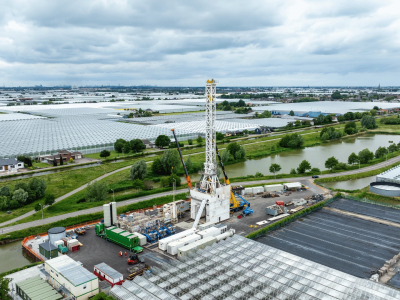
In Cornwall, United Downs is positioned as the UK’s first commercial deep geothermal power project, targeting temperatures above 180 °C at depths of around 5.3 kilometres. The planned 1 to 3 megawatt electric plant would co-produce roughly 15 megawatts thermal and includes a pilot to extract lithium from high-lithium brines. Nearby, Eden Geothermal has drilled to about 4.9 kilometres and is already supplying heat to the Eden Project through a coaxial system, with longer-term ambitions to expand into power generation.
Together, these projects underline recurring themes: drilling risk remains central, community engagement matters, co-production can improve economics, and patient public or blended finance is often decisive in moving from concept to operation.
Scaling to 2050 and closing the policy gap
Project InnerSpace outlines a deployment vision of at least 15 GWth of geothermal heat and 1.5 to 2 GWe of electricity by 2050. Achieving this could support an estimated 80,000 to 170,000 jobs, many of them drawing directly on skills from the oil and gas and mining sectors. Beyond emissions reductions, geothermal heat and thermal storage could also cut peak winter electricity demand and ease grid constraints in a system increasingly dominated by wind and solar.
The report is clear that the main barrier is not resource availability but what it calls the “missing middle” between subsurface potential and financeable projects. Key constraints include exploration and drilling risk, fragmented permitting, unclear heat rights, limited subsurface data access, and weak long-term heat offtake structures.
From assessment to action
For UK and international observers, the report marks a potential inflection point. The UK now has a quantified picture of its geothermal resource, clearly identified anchor loads such as the NHS and data centres, and a concrete set of policy and finance tools to move geothermal from niche to mainstream. For developers, investors, and policymakers, the next signals to watch will be progress on demonstration wells, movement toward a national geothermal strategy, and the institutionalisation of geothermal expertise through initiatives such as a National Geothermal Centre. The lessons learned may also resonate far beyond the UK, offering a template for other non-volcanic, temperate countries seeking to decarbonise heat with domestic resources.